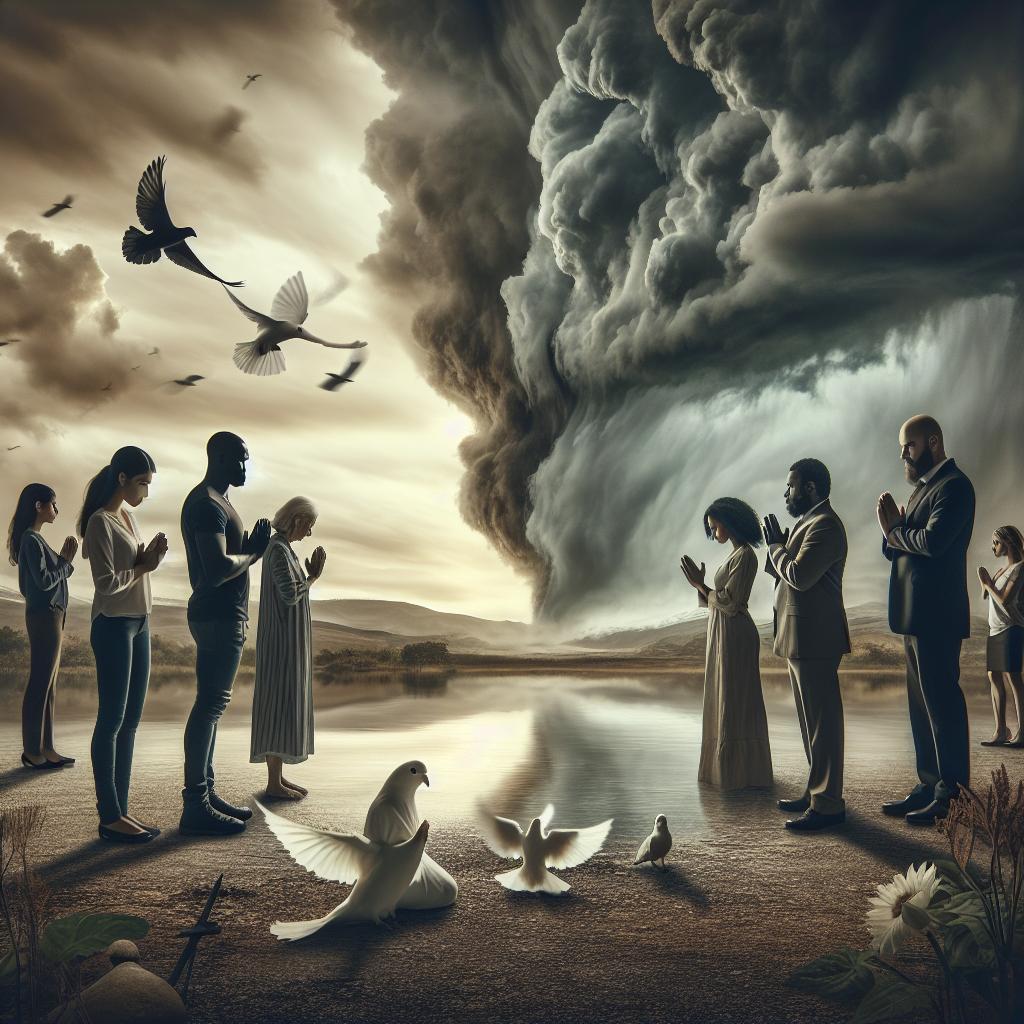
'Unveiling Absolute Reality: The Ultimate Truth for Christian Believers'
Posted on 25 April 2026
Absolute Reality: Understanding the Nature of Truth
What is reality? This question has fascinated philosophers, theologians, and scientists alike. Understanding the concept of reality is fundamental to various fields of study. In this article, we will explore the idea of "absolute" reality and its significance from a Christian perspective. While this complex topic cannot be fully covered in one article, we can gain valuable insights that point us in the right direction.
The Nature of Truth
When discussing reality, the concept of truth comes into play. Truth can be defined as that which corresponds to reality. It is what accurately describes things as they are, distinguishing them from what is not. Absolute reality, then, is synonymous with absolute truth. If reality is not absolute, if there is no ultimate and all-encompassing truth, then there would be no meaningful difference between statements. All statements would be equally valid or invalid.
The very act of asking "what is reality?" assumes a subject that can be defined by statements that are either true or false. Even those who claim everything is relative must make an absolute statement about the way things are. Thus, it is impossible to escape the notion of absolute reality and deny some form of absolute truth. To reject this idea would be to disregard logic itself.
The Christian Perspective on Reality
From a Christian standpoint, the Bible upholds the existence of absolute truth. The Scriptures teach us to distinguish between reality and fiction (Psalm 119:163) and assure us that we can discern the difference (Proverbs 13:5; Ephesians 4:25). This has implications for spirituality, philosophy, and our daily lives. Some things are real and true while others are false beyond personal opinion or knowledge.
In spiritual matters, the concept of truth implies that not all religious ideas can be true. Jesus proclaimed Himself as "the Way, the Truth, and the Life" (John 14:6), indicating that claims contradicting Him cannot be true. The exclusivity of salvation in Christ is supported by passages such as John 3:18 and John 3:36, which state that those who reject Christ cannot hope for salvation. Thus, there can be no reality of salvation apart from Christ.
Philosophically, the Bible's affirmation of truth is significant. Some philosophical perspectives question our ability to truly know what is real. However, according to Scripture, it is possible for us to discern between truth and falsehood (Zechariah 10:2) and between fact and fiction (Revelation 22:15). This knowledge extends beyond personal experience to an "ultimate" level. Contrary to philosophies that claim human knowledge is limited, such as solipsism, Scripture affirms that we have a means to perceive critical truths about absolute reality.
In our daily lives, the Bible's stance on reality refutes the idea of moral relativism. The Scriptures affirm the existence of moral truth, and anything contrary to it is considered sin (Psalm 11:7; 19:9; James 4:17). A long-standing philosophical debate revolves around abstract realities versus concrete realities. Concepts like "length," "happiness," or "the number four" are not tangible themselves but have meaningful connections to concrete things. Similarly, concepts like justice, goodness, and sin are not physically measurable but have real implications. While we cannot physically fill a jar with "good," it does not negate the meaningful reality of goodness.
Understanding Abstractions and Concrete Realities
To fully grasp the biblical perspective on absolute reality, it is crucial to differentiate between our experiences and the reality they are caused by. As human beings, we have the ability to discern the difference between our subjective experiences and a more objective reality. This knowledge arises from our understanding that our feelings and experiences are not always reliable (Jeremiah 17:9). Therefore, we need to compare them to something objective (Romans 12:2; 1 John 4:1). Christianity presumes that there exists an actual point of comparison that we can know.
To illustrate this distinction, let us consider the concepts of light and darkness. Darkness is an abstraction that corresponds to the absence of light. While darkness does not exist as a substance itself, it has a tangible reality as the absence of light. Similarly, coldness is an abstraction that corresponds to the absence of heat. Both darkness and coldness are defined solely in terms of the lack of something else. In the same way, sin is an abstraction. It is "real" only in relation to goodness, which God created as an ideal or abstraction. Sin exists as the absence of goodness, just as darkness exists as the absence of light.
Why This Matters
Understanding absolute reality is crucial because it shapes our worldview and influences how we interact with the world around us. Recognizing that there is an ultimate truth that corresponds to absolute reality helps us navigate spiritual, philosophical, and moral questions. It enables us to discern between truth and falsehood, between right and wrong.
Think About It
Consider how your understanding of absolute reality affects your daily life. How does knowing that there is an objective truth impact your decisions and interactions with others? Reflect on the significance of aligning your beliefs and actions with a standard grounded in absolute reality.
