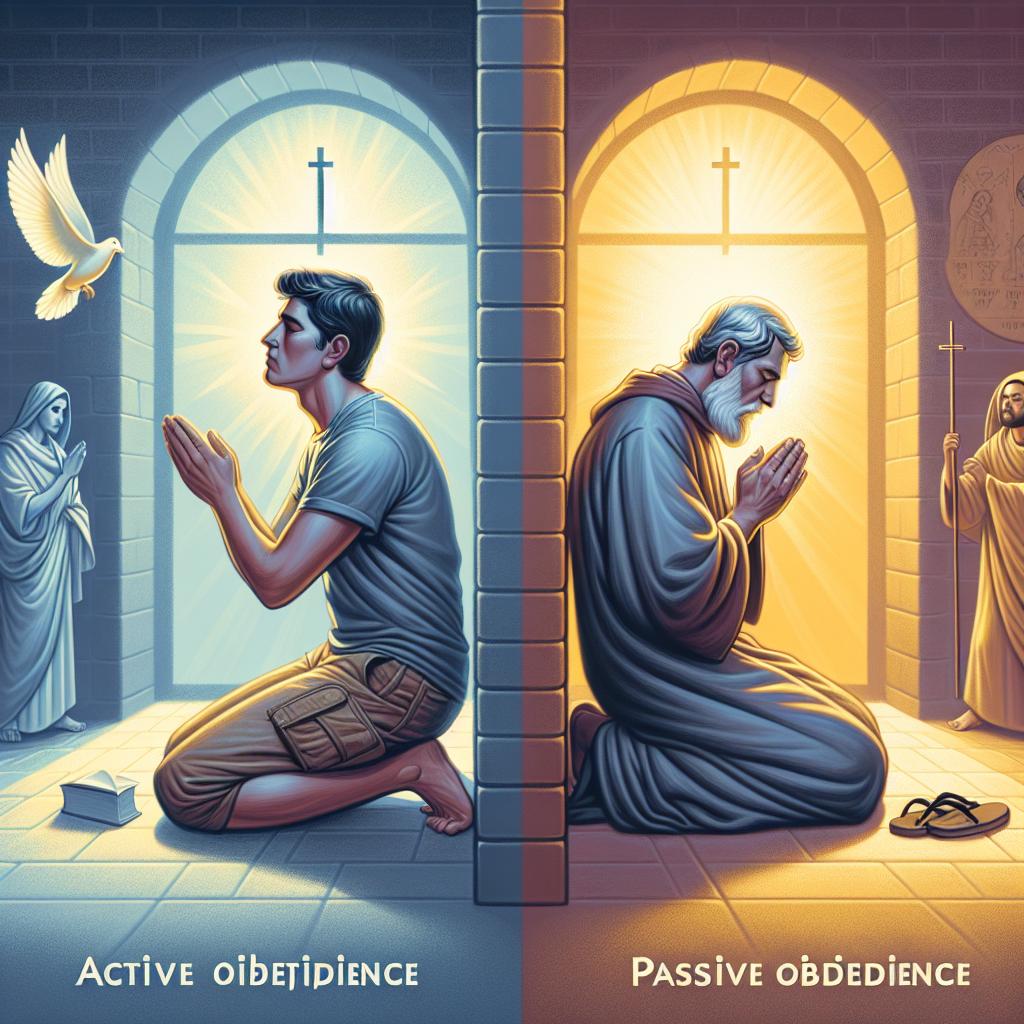
'Unlocking the Power of Active Passive Obedience in Christianity: A Comprehensive Guide'
Posted on 29 April 2026
Active Passive Obedience
Active obedience and passive obedience are two concepts that Christians often encounter in their spiritual journey. These concepts refer to the different ways in which believers are called to obey God's commands. While these terms may sound complex, they can be understood by breaking them down into simpler ideas.
Active Obedience
Active obedience involves actively seeking out and obeying the commands of someone else. In the context of our relationship with God, active obedience means actively seeking out His commands and setting our hearts to do them. It requires us to actively pursue a relationship with God and actively strive to live according to His will.
An analogy that helps illustrate active obedience is that of a student and a teacher. When a student listens attentively in class, takes notes, and completes assignments, they are actively obeying the teacher's instructions. Similarly, when we actively seek out God's commands through reading the Bible, prayer, and seeking His guidance, we are demonstrating active obedience.
Passive Obedience
Passive obedience, on the other hand, involves total submission to another, even when harm or suffering may result. It implies non-resistance and surrendering our will to God's will. In the context of our relationship with God, passive obedience means submitting ourselves fully to God's plan and purposes, even when it may be difficult or challenging.
An example of passive obedience can be seen in Jesus' life. When Jesus prayed in the Garden of Gethsemane before His crucifixion, He said, "Not my will but yours be done" (Luke 22:42). This prayer exemplifies passive obedience as Jesus willingly submitted Himself to God's will, even though it meant enduring great suffering.
Active and Passive Obedience in Jesus' Life
Jesus is the perfect example of both active and passive obedience. Throughout His ministry on earth, He actively sought out God's commands and faithfully lived according to them. Jesus fulfilled every requirement of the law, stating, "I always do those things that please Him" (John 8:29).
At the same time, Jesus also demonstrated passive obedience by submitting Himself to the cruel and unjust treatment that led to His crucifixion. Despite facing insults and suffering, Jesus did not retaliate or make threats but entrusted Himself to God who judges justly (1 Peter 2:23). Through His passive obedience, Jesus fulfilled God's plan for our salvation.
The Importance of Active and Passive Obedience
As Christians, we are called to both active and passive obedience. Passive obedience involves surrendering our will to God's will and trusting in His plan for our lives. It requires us to endure hardships, knowing that God is working everything together for our good (Romans 8:28).
Active obedience, on the other hand, involves actively seeking out and obeying God's commands. It requires us to deny ourselves and take up our crosses, pursuing holiness and loving one another as Christ loved us (Luke 9:23; Hebrews 12:14; 1 Peter 1:22).
Both active and passive obedience are necessary for a fulfilling Christian life. By actively obeying God's commands and surrendering ourselves to His will, we bring glory to Him and live in alignment with His purposes.
Why This Matters
Understanding the concepts of active and passive obedience is important because they shape our relationship with God. Knowing that we are called to actively seek out God's commands and passively submit to His will can help us navigate through life's challenges and make decisions that are pleasing to Him.
Furthermore, understanding active and passive obedience can deepen our appreciation for what Jesus accomplished through His life, death, and resurrection. Jesus perfectly exemplified both active and passive obedience, fulfilling every requirement of the law and willingly laying down His life for our salvation.
Think About It
How can you actively seek out God's commands in your daily life? What practical steps can you take to grow in active obedience?
In what areas of your life do you struggle to passively submit to God's will? How can you cultivate a greater sense of surrender and trust in His plan?
Reflect on Jesus' example of active and passive obedience. How does His life inspire you to live a life of obedience to God?
Remember, active and passive obedience are not separate concepts that exist in isolation. They are intertwined aspects of our relationship with God that work together to shape us into the people He has called us to be. By actively seeking out His commands and passively submitting to His will, we can walk in obedience and bring glory to our Heavenly Father.