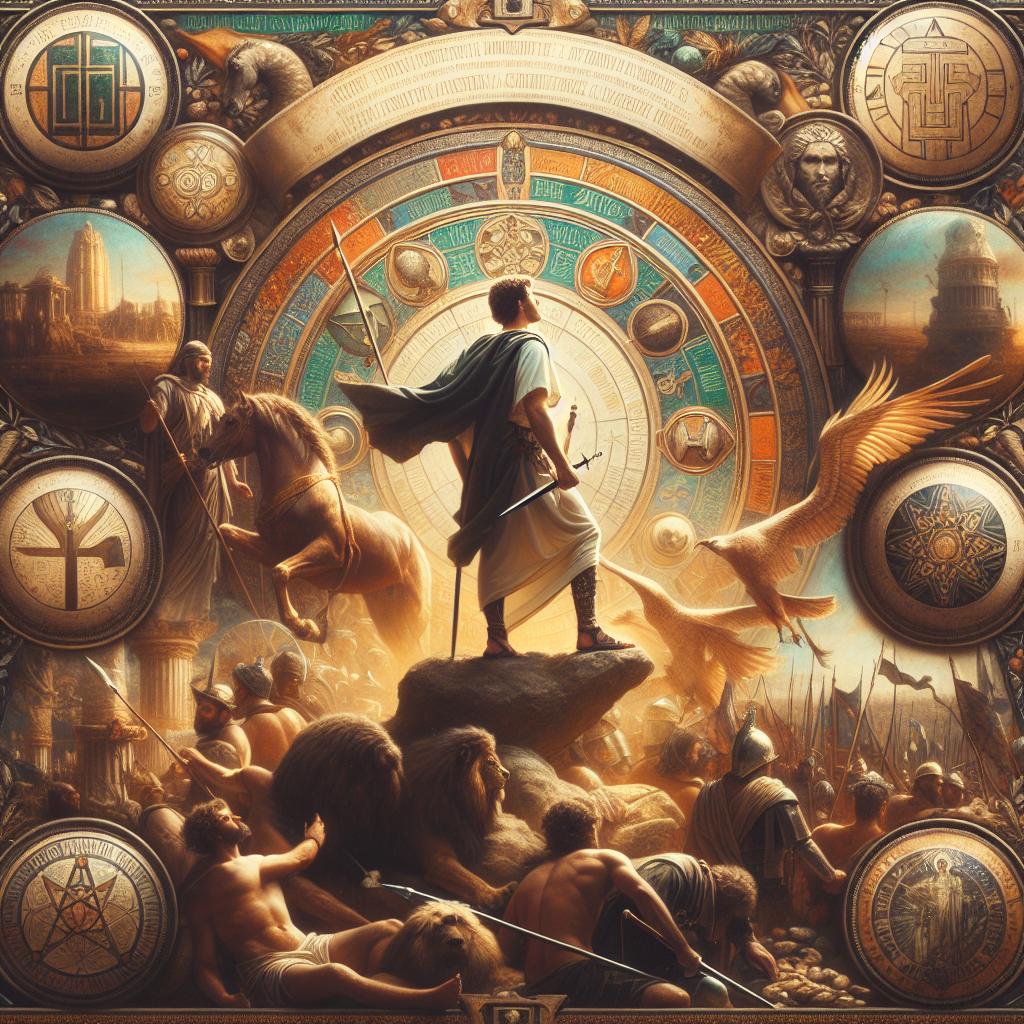
'Divine Insights into Alexander the Great: Unveiling His Faith Journey'
Posted on 04 May 2026
Alexander the Great: A Biblical Perspective
Introduction
The name "Alexander the Great" may not appear in the Bible, but the prophets Daniel and Zechariah wrote prophecies that mentioned Greece and Alexander's Macedonian Empire. These prophecies provide fascinating insights into Alexander's rise to power and the impact of his conquests. Although Alexander's empire eventually split, his legacy of Hellenism continued to shape the world for centuries.
Why This Matters Understanding the biblical perspective on Alexander the Great helps us see how God's prophecies were fulfilled and how historical events fit into His plan. It strengthens our faith in the accuracy of Scripture and demonstrates God's sovereignty over human history.
Prophecies in Daniel
Daniel, a prophet who wrote in the sixth century B.C., predicted many future events with remarkable accuracy. He prophesied that there would be four successive global empires, including the Greek Empire. In Daniel chapter 2, King Nebuchadnezzar had a dream of a statue made of different metals, each representing a different kingdom. The first kingdom, identified as Babylon, was followed by the Medo-Persian, Greek, and Roman empires.
Think About It The fulfillment of these prophecies reinforces the divine inspiration of Scripture. The intricate details predicted by Daniel demonstrate God's knowledge of future events and His control over human history.
Alexander's Conquests
Alexander the Great, born in 356 B.C., only reigned for 13 years but left an enduring legacy. His conquests resulted in one of the largest empires in ancient history, encompassing Asia Minor, Persia, Egypt, and Israel. Despite dying undefeated in battle, Alexander did not leave a clear heir, leading to the division of his empire among his generals.
Why This Matters Alexander's conquests had a significant impact on Israel and the region. Understanding the historical context helps us see how God's plans unfolded and how the Jewish people navigated through changing empires.
Spread of Hellenism
Although Alexander's empire split after his death, the influence of Greek culture, known as Hellenism, continued. Greek became the universal language, and Greek culture was either required or encouraged in all parts of the divided empire. Israel came under the control of both the Ptolemaic and Seleucid kingdoms. Eventually, Israel gained independence during the Hasmonean Period (167–63 B.C.) before falling under Roman rule in 63 B.C.
Think About It The spread of Hellenism affected not only political boundaries but also cultural and linguistic aspects. It highlights the interconnectedness of different civilizations and provides a backdrop for understanding the New Testament, which was written in Greek.
Daniel's Vision of the Ram and Goat
In Daniel chapter 8, Daniel received a vision that specifically mentioned the Medo-Persian and Greek empires. The vision used highly symbolic imagery to represent these kingdoms. A ram with two horns represented the Medo-Persian empire, which overtook Babylon in 539 B.C. Then a goat "from the west" appeared with a single horn between its eyes, symbolizing Alexander the Great. The goat defeated the ram, but at the height of his power, Alexander died unexpectedly.
Why This Matters Daniel's vision provides a profound insight into Alexander's rise to power and his untimely death. It illustrates God's sovereignty over human affairs and demonstrates how He uses even powerful rulers to accomplish His purposes.
The Division of Alexander's Empire
In Daniel's vision, the single horn on the goat was replaced by four new horns that represented four kingdoms emerging from Alexander's nation but lacking his power. This division accurately predicted what happened after Alexander's death when his empire was divided among his generals.
Think About It The division of Alexander's empire into four parts, as prophesied by Daniel, demonstrates the precision and accuracy of God's foreknowledge. It reminds us that God's plans are not limited by human actions and that He orchestrates events according to His purposes.
Daniel's Reliable Prophecies
Approximately 250 years before Alexander's conquests, God provided Daniel with a glimpse into the future. These prophecies were crucial for Daniel and his people, assuring them of God's faithfulness and their eventual return to their land. Despite the rise and fall of kingdoms, God holds the future, and His Word remains steadfast.
Why This Matters Daniel's reliable prophecies strengthen our confidence in the trustworthiness of Scripture. They remind us that God is in control of history and that we can rely on His promises even in turbulent times.
Conclusion
Examining Alexander the Great from a biblical perspective reveals the fulfillment of prophecies and God's sovereignty over human history. While Alexander's empire left a lasting impact, it eventually fragmented, as foretold by Daniel. Understanding these historical events deepens our appreciation for God's Word and strengthens our faith in His providence.
Think About It Reflecting on the fulfillment of biblical prophecies encourages us to trust in God's plans for our own lives. Just as He guided and directed the rise and fall of empires, He is actively working in our lives today.