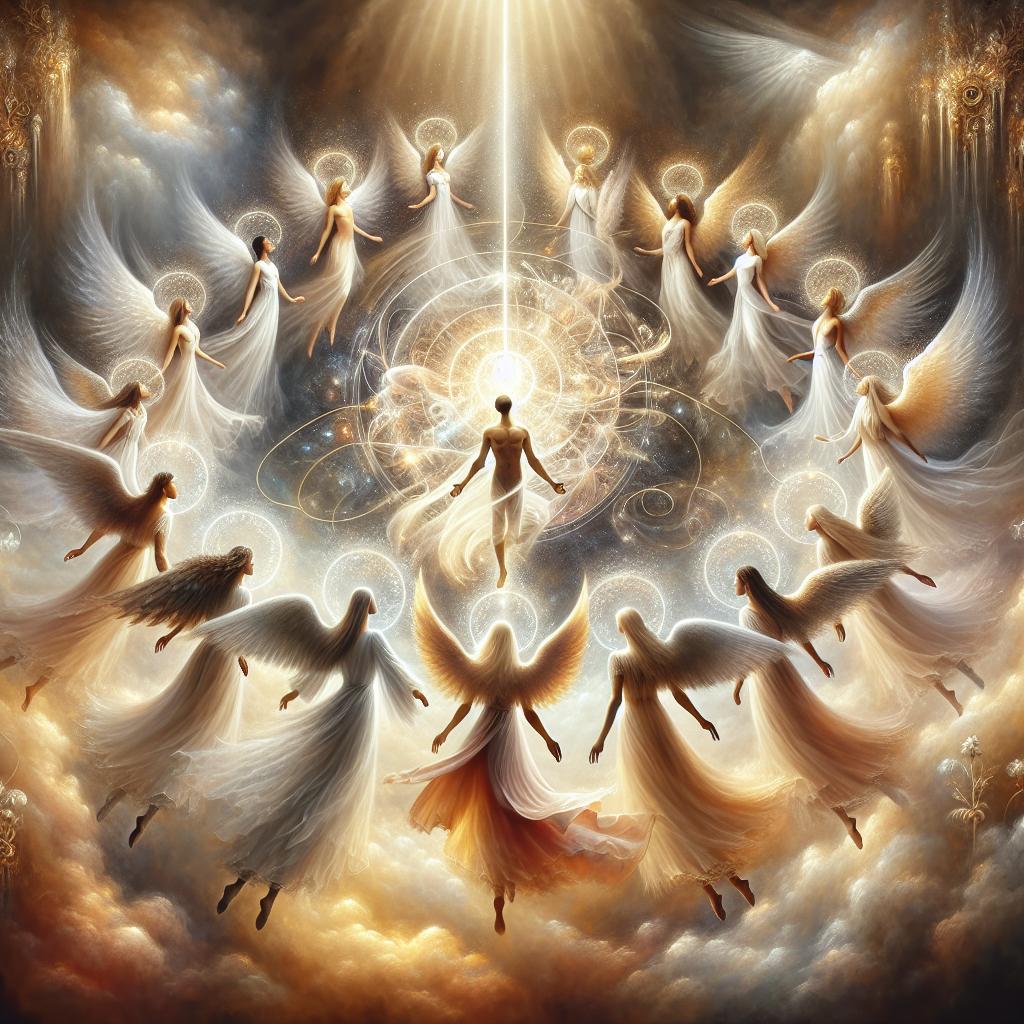
'Divine Revelation: Unveiling the Angelic Dance of Faith'
Posted on 15 May 2026
Angels Dancing on the Head of a Pin
The question of how many angels can dance on the head of a pin has historical roots in the Middle Ages. During that time, it was a serious topic of discussion among scholars known as scholastics. While the question may seem trivial or even absurd, it served as a starting point for contemplating the nature of angels, spirits, physical space, and other theological and philosophical concepts.
Angels and their Physical Presence
One perspective on the question was provided by Thomas Aquinas, a prominent theologian of that era. Aquinas argued that since two angels cannot be in the same place at the same time, only one angel could occupy the point of a needle or the head of a pin at any given moment. This viewpoint suggests that there is a limitation on the number of angels that can physically exist in a confined space.
The Nature of Angels and Space
However, others in the debate pointed out that angels are spirits and not bound by physical limitations like humans. As spirits, there is no inherent restriction on the number of angels that could fit on the point of a needle or the head of a pin. It is important to note that if angels are indeed spiritual beings, it might be incorrect to consider them as being "on" anything physical.
Looking at the question from a different angle, if angels were to assume bodily form (as they do in certain instances mentioned in Scripture), how small could they make themselves? This line of thinking raises questions about the size and capabilities of angels. For instance, could angels become as small as bacterial cells? And if so, how many could fit on the head of a pin or the point of a needle? Furthermore, could angels make themselves even smaller than that, such as the size of electrons?
The Reformation Perspective
With the advent of the Reformation, Protestant theologians began to criticize this type of speculative and seemingly fruitless debate. They argued that theologians should focus on the more crucial matters of salvation and eternity, rather than engaging in discussions that appeared inconsequential. The question of how many angels could dance on the head of a pin became a symbol of such unimportant academic debates.
The Value of Contemplation
The original intent behind the question was not necessarily to determine a definitive answer. Instead, the medieval scholastics were using it as a means to explore theological and philosophical concepts. While their contemplations may have been valuable in contributing to a greater understanding of biblical truth, it is important to remember that knowledge alone is not an end in itself.
As Jesus pointed out, even diligently studying the Scriptures does not guarantee eternal life if one fails to recognize Him as the source of life. It is crucial to approach theological and philosophical inquiries with the intention of deepening our relationship with God and seeking His truth.
Why This Matters: The question of how many angels can dance on the head of a pin serves as a reminder for Christians to prioritize what truly matters in their faith. While intellectual pursuits can be valuable, they should not overshadow the central tenets of Christianity, such as salvation through Jesus Christ. Engaging in deep theological and philosophical discussions can enhance our understanding, but it is vital to maintain a focus on practical application and personal relationship with God.
Think About It: Consider how you approach intellectual pursuits within your faith. Are you seeking knowledge solely for its own sake or with the aim of drawing closer to God and understanding His truth? Reflect on whether your intellectual pursuits align with the priorities outlined in Scripture and how they contribute to your spiritual growth. Remember that while seeking answers to complex questions can be beneficial, it is ultimately our relationship with God that brings true life and salvation.