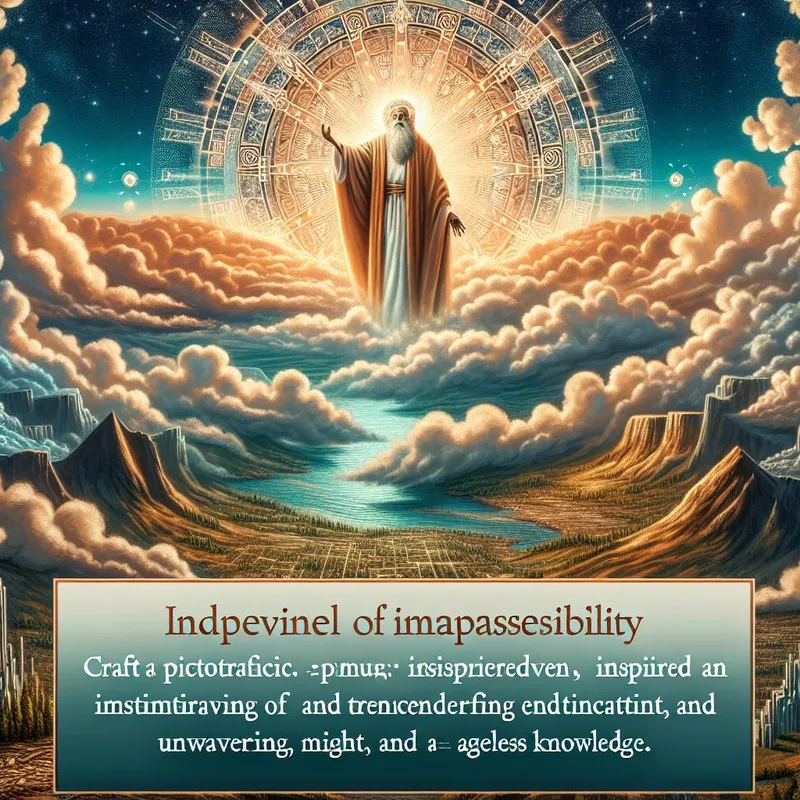
'Unlocking Divine Mysteries: The Antinomy Dilemma in Christian Faith'
Posted on 22 May 2026
Antinomy: Understanding the Conflict of Laws
Antinomy, derived from the Greek words "anti" meaning "against or in opposition to" and "nomos" meaning "law," is a concept used in philosophy to describe the conflict between two mutually exclusive or contradictory laws. When two logically sound conclusions contradict each other, it results in an antinomy.
The Paradox of Truth
To illustrate antinomy, let's consider the statement: "This sentence is false." At first glance, this may seem like a trivial paradox. The statement claims that it is false, but if it is false, then it must be true. This contradictory nature of the statement is an example of antinomy.
Another example is the statement "There is no absolute truth." This statement creates a conflict within itself. By claiming that there is no absolute truth, the speaker is asserting a truth. This contradiction highlights the presence of antinomy.
Immanuel Kant and Antinomy
Philosopher Immanuel Kant extensively explored the concept of antinomy. He focused on the conflict between rational thought and sensory perception. Kant argued that empirical thought cannot prove rational truth. He identified four specific antinomies where a thesis and an antithesis cancel each other out.
In one of Kant's antinomies, he addresses the idea that time must have had a beginning. Infinity is timeless, and timelessness cannot exist within a timeline. However, we exist in a world that experiences the passage of time, which contradicts the notion of infinity. On the other hand, if time had a beginning, there must have been a pretemporal void before time began. But how could time come into existence if nothing ever changes in a timeless void? These apparent paradoxes demonstrate that pure reason does not always lead to absolute truth.
The Limitations of Human Understanding
The existence of antinomy reminds us of the limitations of the human mind and intellect. Our understanding is finite and fallible. Even two equally true rational statements can be disproven when compared to each other. This demonstrates that there are aspects of the universe that surpass our ability to comprehend.
The Bible teaches humility as a virtue (James 4:6). In the story of Job, we see how Job struggled to understand God's purpose in allowing his suffering. Job, in his confusion, came to incorrect conclusions about God's intentions. When God responded, He did not provide an answer to Job's confusion but displayed His power and glory. Job humbly acknowledged that he had spoken about things beyond his understanding (Job 42:3).
Antinomy serves as a reminder that we should trust in the Lord rather than relying solely on our limited understanding (Proverbs 3:5). It does not mean that God withholds truth from us or hides something from us; rather, it acknowledges that our understanding is restricted by our fallen nature. It is possible that God has provided us with all the information our mortal minds can handle. As created beings, we simply lack the capacity to fully comprehend the intricate workings of the universe and the mind of God who created it.
The Foolishness of Man's Wisdom
Antinomy arises from our finite attempts to grasp the infinite and ultimately leads to our realization of our own limitations. The apostle Paul points out that the world cannot know God through human wisdom (1 Corinthians 1:18–25). The gospel, which appears foolish to those who rely solely on rational thinking, is the message of the cross of Christ.
In Acts 17:32, when Paul mentioned the resurrection, philosophers on Mars Hill scoffed at him. Without knowledge of Jesus Christ, who is truth and the wisdom of God (John 14:6; 1 Corinthians 1:24), mankind can never truly know the truth.
Why This Matters
Understanding antinomy and our limitations as finite beings is essential for our faith journey. It reminds us to approach God with humility, acknowledging that we cannot fully comprehend His ways. It encourages us to trust in Him, even when we don't understand the reasons behind certain events or circumstances in our lives. Antinomy teaches us that seeking absolute truth solely through our own understanding is futile.
Think About It
- How does the concept of antinomy challenge your understanding of truth?
- Are there areas in your life where you struggle to trust God because you don't fully understand His purposes?
- How can embracing humility and acknowledging our limitations enhance our relationship with God?
In conclusion, antinomy reveals the conflict between two opposing laws or conclusions. It serves as a reminder of our finite understanding and points us towards trusting in God's wisdom rather than relying solely on our own reasoning. Embracing humility and recognizing our limitations can deepen our faith and draw us closer to God, who is the source of absolute truth.